Protect the Joy — 51-Species Offline Field Guide
Bilingual English/Spanish field guidebook, 50 rotatable 3D hummingbirds, and an 802-plant Mesoamerican nectar guide built to work offline from British Columbia banding stations to Andean cloud-forest reserves.
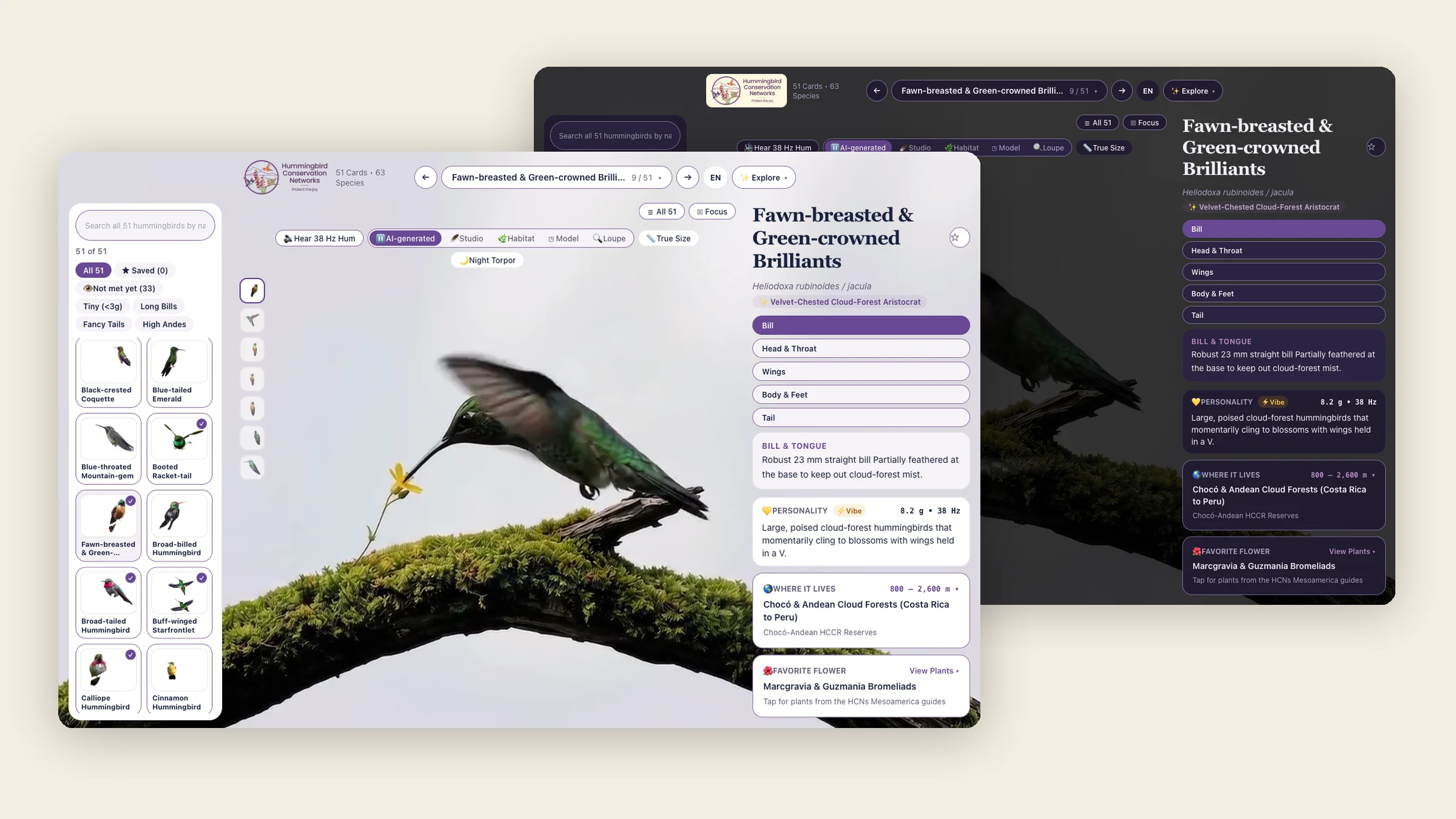
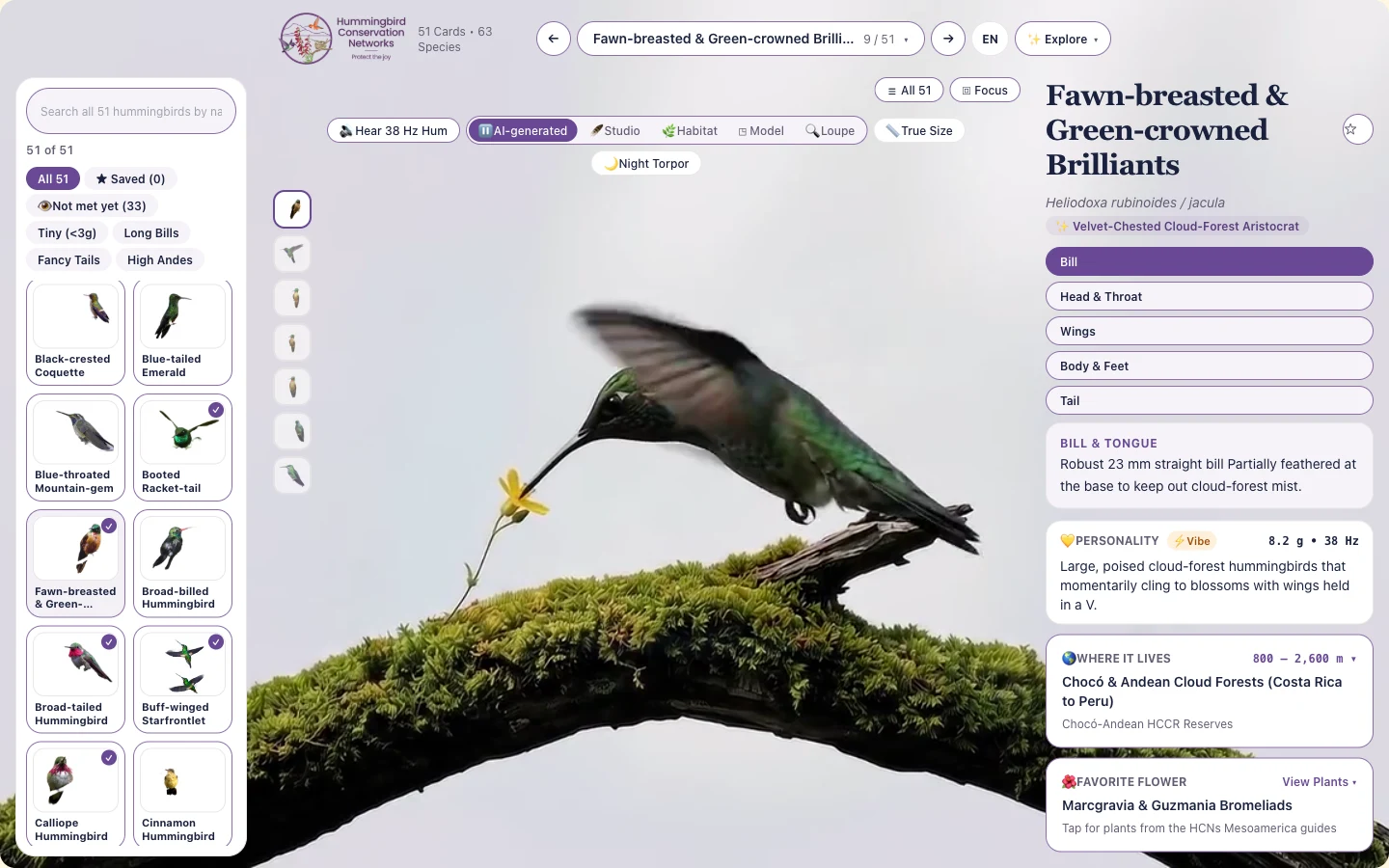
Turned 231 studio cutouts, 30,743 monitoring captures across 18 stations, and four regional plant PDFs into a static offline-capable field guide covering 51 cards (63 species) in English and Spanish, paired with a 27-page two-level Framer site restructured from a 57-link outline without inventing a word of client copy.
The Constraint
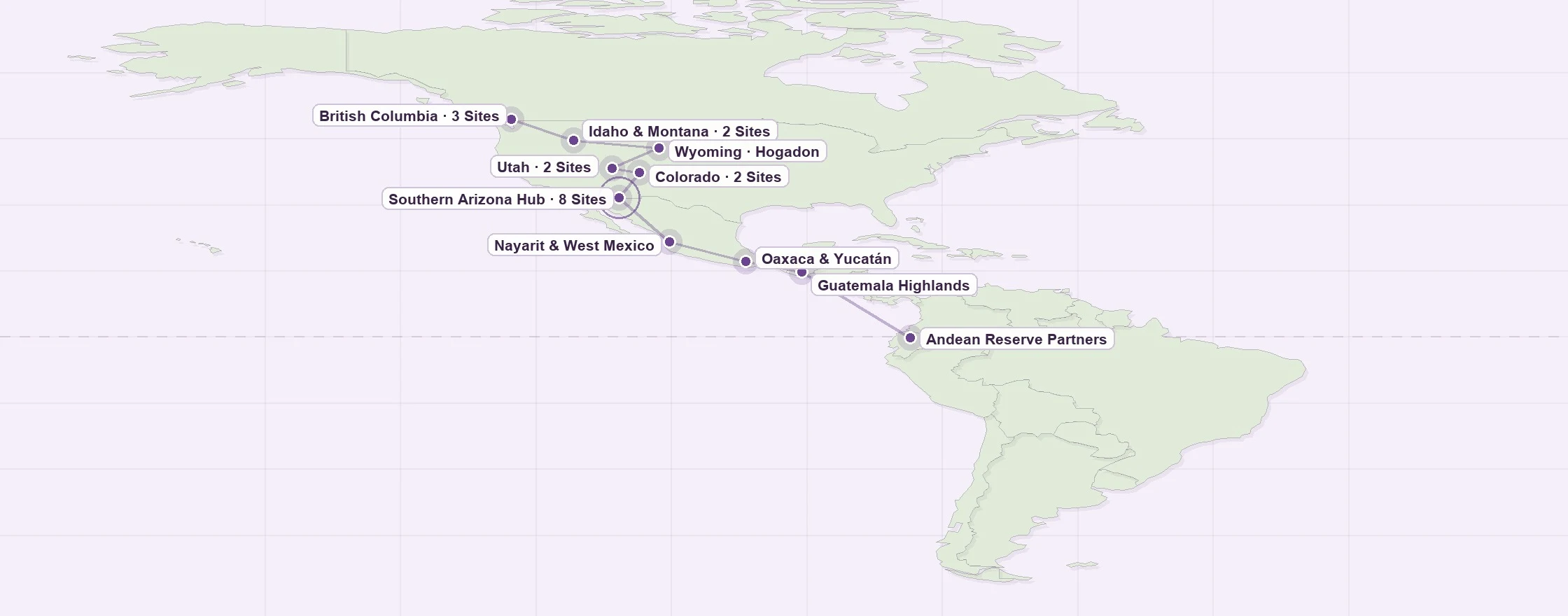
Hummingbird Conservation Networks (HCNs) runs monitoring stations, school gardens, and community-held cloud-forest reserves from British Columbia and Southern Arizona down through Mexico, Guatemala, and the Andes — 30,743 capture records across 18 monitoring sites, 231 high-resolution studio cutouts across 51 species cards (63 species total), and four regional native nectar plant guides.
The raw material was extraordinary, and almost none of it could be used in the field. The species photography lived in nested desktop folders with photographer shorthand in the filenames (ml perch 300 fnl copy 2, Oasis (iffy)). The plant guides were locked inside regional documents for Guatemala, Oaxaca, Nayarit, and Yucatán. Meanwhile, the draft website outline had grown to 57 menu entries across three levels of dropdowns, orphan pages with conflicting titles, and 12 pages missing a phone breakpoint — squeezing two-column cards down to 135 px on a 375 px screen and snapping Spanish and scientific words mid-syllable.
A field guide for cloud-forest reserves has two hard rules: it has to work in Spanish as naturally as English, and it cannot blank out when an iPad loses cell reception at 2,600 meters.
Zero-Backend Architecture & The Cross-Origin Cache Trap
I deliberately avoided putting a live database behind the guidebook. Instead, build_guidebook.py compiles modular JSON tables — morphometrics, hover-versus-torpor metabolism, 12-month migration phenology, monitoring sites, Mesoamerican nectar matches, and full Latin American Spanish translations — into a deterministic static bundle (guidebook/) guarded by a service worker (sw.js). Once opened on Wi-Fi at headquarters, an iPad carries the entire 51-card dataset into the forest.
Testing airplane mode exposed a bug that standard Lighthouse PWA checks miss. On first pass, Tailwind loaded from a remote CDN script tag. Because a service worker cannot cache cross-origin scripts into its verified offline shell the same way, opening the cached app with Wi-Fi off restored the HTML and species JSON cleanly — and rendered the entire interface completely unstyled. Vendoring vendor/tailwind.min.js same-origin into CORE_ASSETS closed the hole.
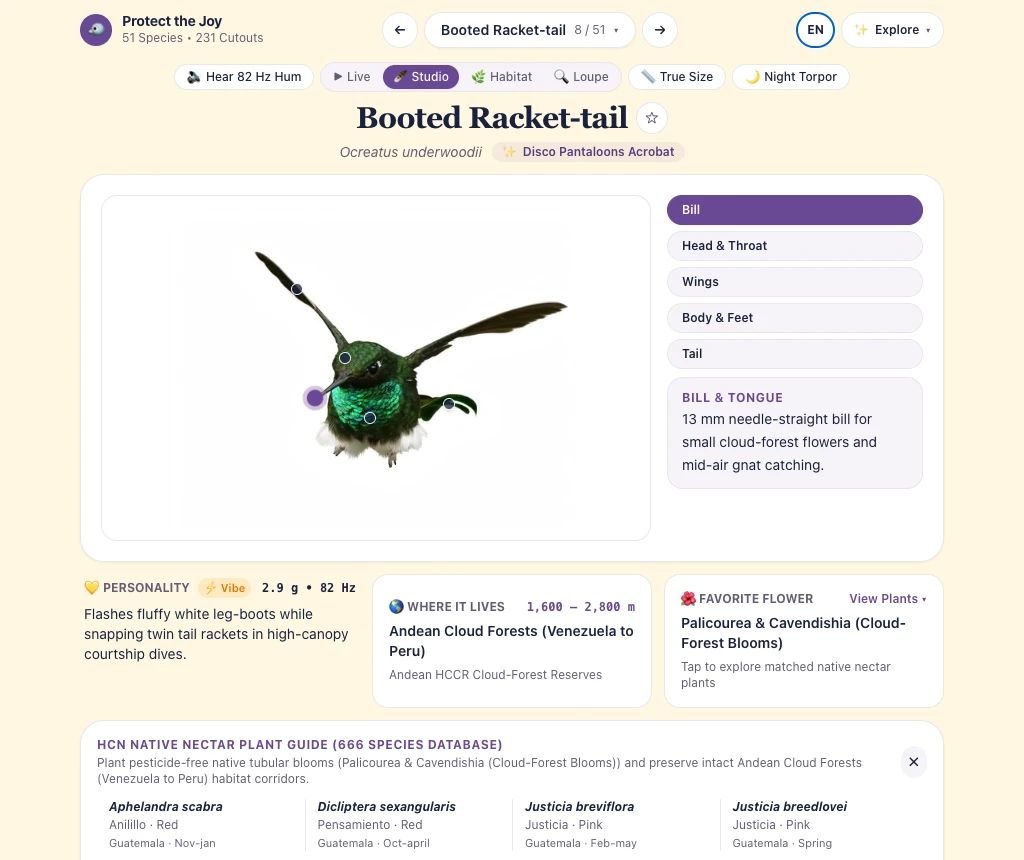
Audio had the same constraint. Shipping 51 recorded wingbeat files would bloat the offline cache and still miss half the species. Because a hummingbird’s hum is driven by its wingbeat frequency (31 Hz on the giant Sword-billed up to 82 Hz on the Booted Racket-tail) plus soft figure-eight stroke harmonics, I synthesized each species’ hum client-side in Web Audio. Zero audio bytes travel over the network.
Three cards from the 51-species offline bundle
Flip between English and Spanish, toggle daytime hover against night torpor, or synthesize each bird’s wingbeat fundamental via Web Audio — zero audio files over the wire.
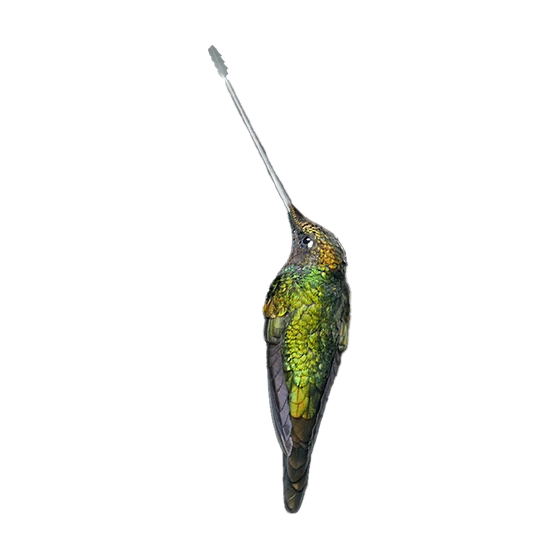
Sword-billed Hummingbird
High-Andean HCCR Corridors · Venezuela to Bolivia
Heart rate
900 bpm
2,500 blooms/day
Body temp
40.5 °C
night 9.5 °C
Bill vs total length
105 mm
49% of 21.5 cm
Mass (penny scale)
12.5 g
≈ 5 US pennies
Only bird on Earth whose 105 mm bill outgrows the rest of its body. Supporting 12.5 g at 3,000 m takes ~2,500 flower visits by day, then 9.5 °C torpor at night with the bill pointed straight up to stay balanced on the branch.
Co-evolved nectar match
Passiflora mixta & Brugmansia sanguinea (11 cm corolla)
Matched to deep trumpetvines in the Guatemala & Andean reserve guides
Every number above comes straight from morphometrics_51.json and torpor_metabolism_51.json in the static build that caches onto field iPads.
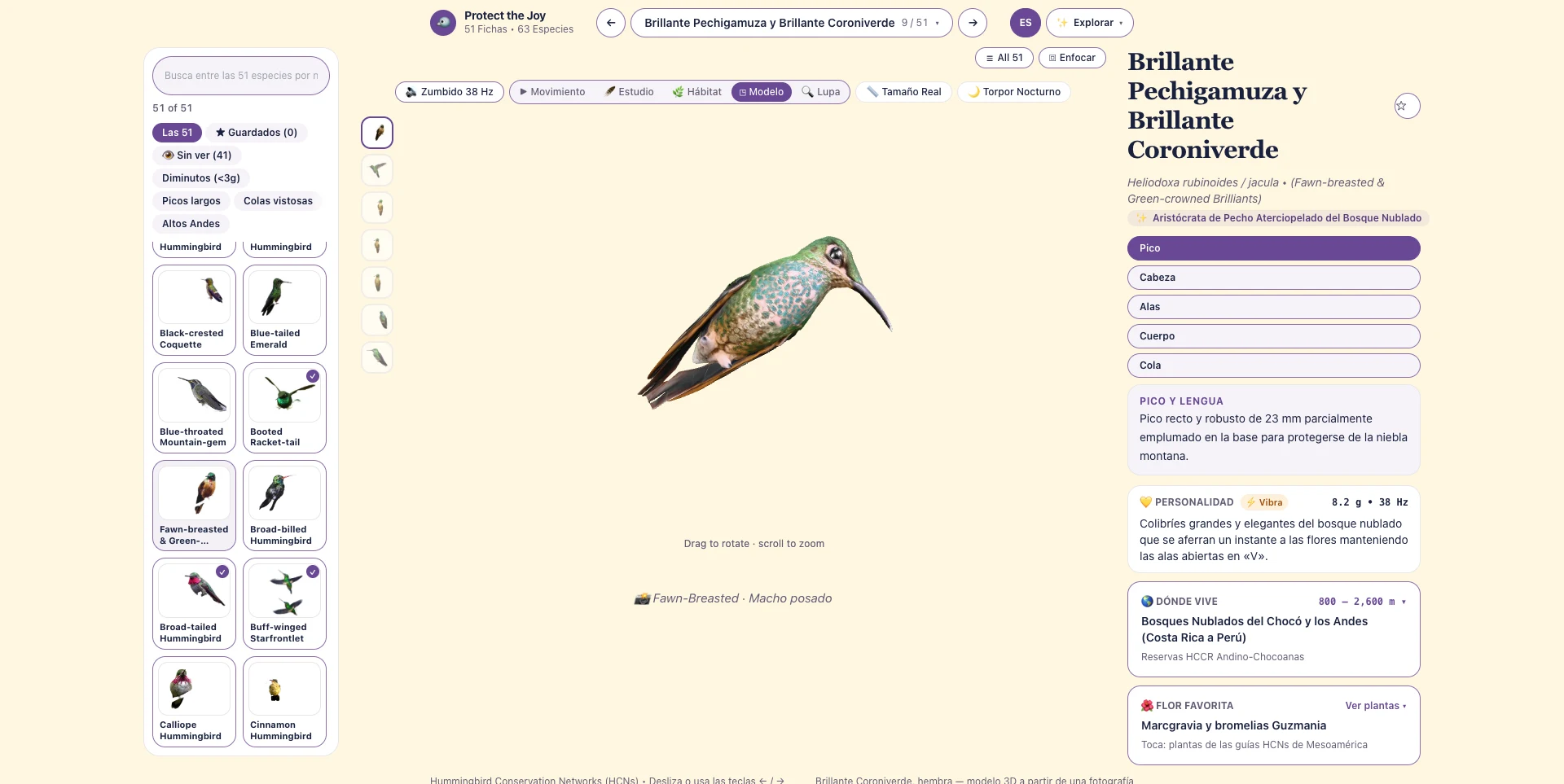
50 Rotatable 3D Birds, Perch Holes & Structural Colour
A flat studio photo hides how bill curvature, wing-tip projection, and tail forks sit in space. I wanted visitors and students to rotate the birds in 3D (Model view) on 50 of the 51 cards. Getting single-photo 3D reconstruction to look like ornithology instead of melted wax took solving three separate problems.
I benchmarked Tripo H3.1 against Hunyuan3D v3 on identical studio cutouts first. Hunyuan squashed perched birds into a near-cubic bounding box (1 : 1.06 : 0.95). Tripo preserved elongated avian proportions (1 : 2.54 : 2.68, 1.97M triangles) but spat out 66–69 MB GLBs per bird — unusable over mobile data. Using gltf-transform optimize, I simplified each mesh and shrank its textures, landing at 198–628 KB per bird (over 100× smaller). Crucially, I ran it with --compress false rather than Draco: a Draco file needs a ~250 KB WebAssembly decoder fetched at runtime, one more thing to fail on an offline field iPad.
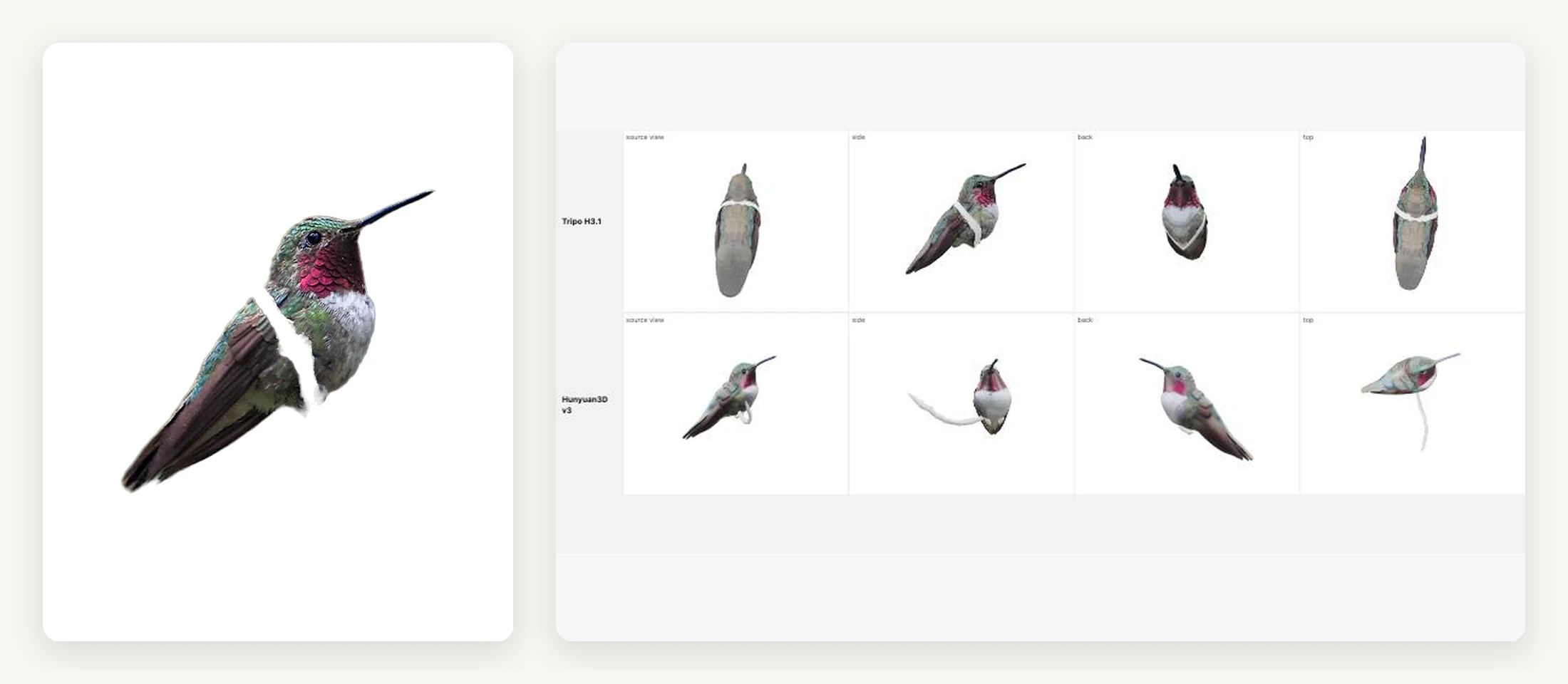
The funnier failure came from the source cutouts. Wherever a branch had crossed in front of a perched bird, automated background removal left a clean transparent gap slicing the bird in two. Neither 3D model knew a branch used to be there — Tripo wrapped that gap into a white harness around the chest, and Hunyuan grew a pale root out of the sternum. Rather than burning API credits to spot broken poses by eye, I wrote scan_cutouts.py to score all 231 cutouts on alpha-silhouette continuity before generation (126 scored 0.000 intact; 31 scored above 0.3 broken), painted back the missing chest plumage on severed birds, and separated two-bird frames so each species generated from a single closed silhouette.
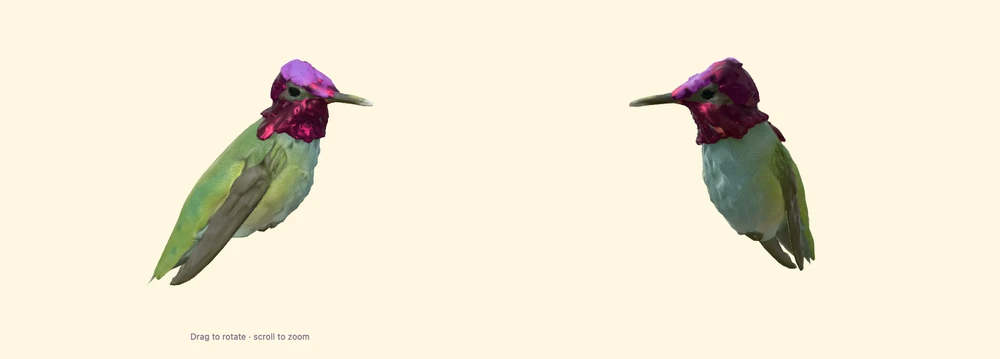
Even with a clean mesh, male hummingbirds looked wrong when rotated. A male gorget (throat patch) isn’t red or violet pigment — it’s structural colour caused by thin-film interference inside microscopic melanin platelets. Head-on, an Anna’s Hummingbird flares bright rose-magenta; forty degrees off-axis, the exact same feathers turn velvety black. A baked texture painted flat magenta all the way around the crown. Higher resolution couldn’t fix physics, so I masked the gorget region in Three.js and drove specular flare from dot(viewVector, normal) so the throat ignites as you orbit past the camera and falls dark as you turn away.
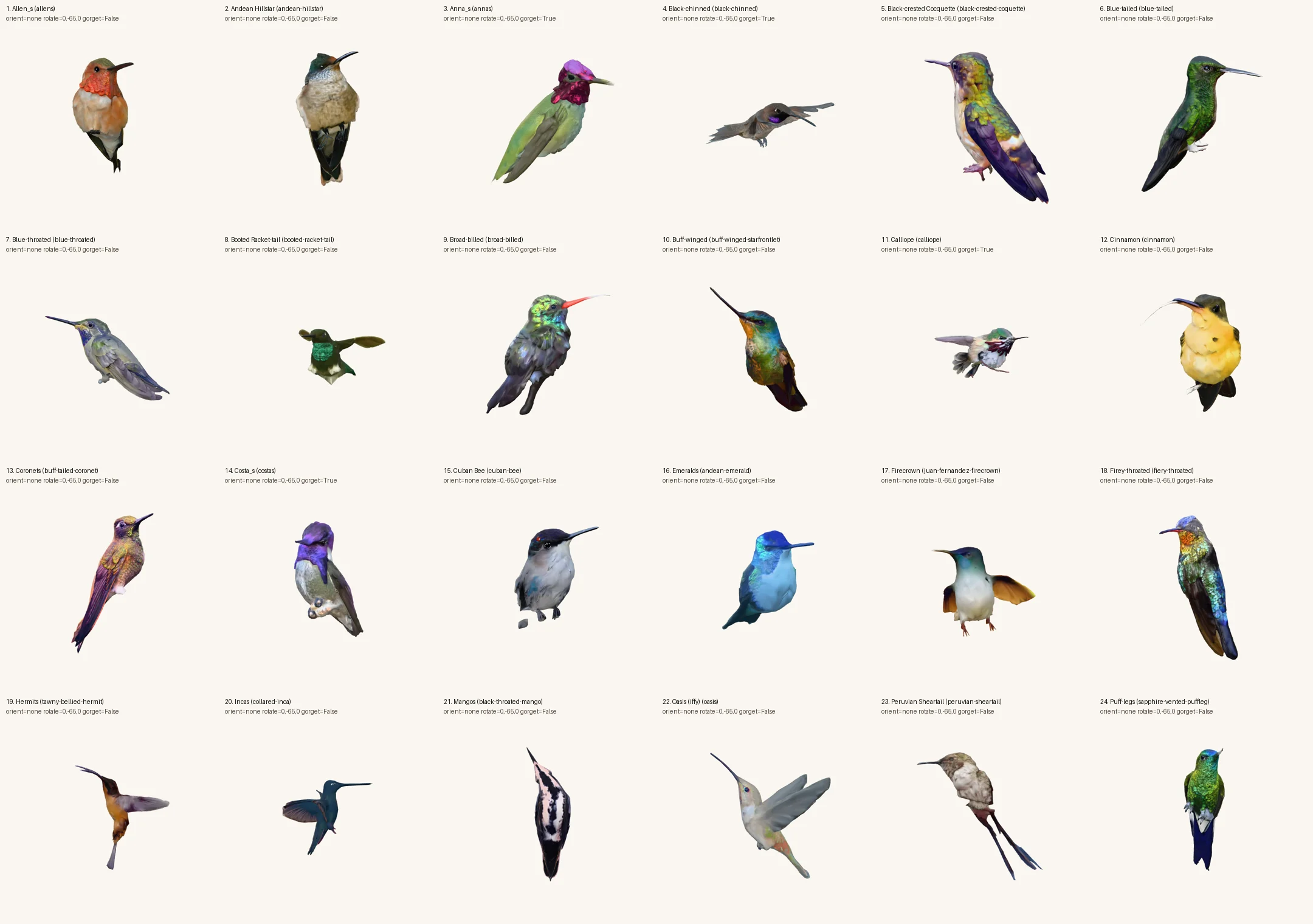
802 Nectar Plants & Folding a 57-Link Site Into Two Levels
Saving hummingbirds on the ground comes down to what communities plant along migration and reserve corridors. I parsed HCNs’ four regional plant guides — Guatemala, Oaxaca, Nayarit, and Yucatán — into a unified 802-entry searchable database (PlantSearch.tsx), complete with bloom-season filters, sun/water badges, and direct links from every hummingbird card’s Favorite Flower drawer.
The raw tables had botanical names and local Spanish/Mayan names (Ojo de luna, Poch k'aak', Mirto morado), but no flower photos. I wrote fetch_photos.py against the iNaturalist API restricted to Creative Commons observations, matching 762 of the 802 species with per-photographer licence strings and building a dedicated Photo Credits page. For the 40 rare highland plants with zero verified Creative Commons flower observations, the card explicitly says Photo to come rather than scraping uncredited images or risking a wrong species match.
Around the guidebook, I restructured the rest of the organization’s Framer site (page-map-october-2026.md). The client’s July outline had 57 menu items nested three levels deep, duplicate programme pages, and 12 routes with no mobile breakpoint (810 px desktop grids crushed onto phones). I folded the architecture into 6 top-level sections and 27 pages, aligned every browser <title>, eyebrow, h1, nav link, and footer link so visitors never land on a page named differently from the button they clicked, and rebuilt mobile layouts across all 12 broken routes — strictly reorganizing approved client text without inventing copy for sections still waiting on field biologists.
Key Decisions
Static JSON build + Service Worker over a live CMS API
Context
Framer CMS and cloud databases are convenient at a desk, but reserve educators and banders use iPads in cloud forests where cellular data drops to zero.
What I chose
Compiled all 51 cards, 231 cutout poses, translations, and metabolic tables via Python into a self-contained static bundle with same-origin vendored Tailwind and Service Worker precaching.
Tradeoff
Updating species data runs through `build_guidebook.py` rather than a live web form, in exchange for instant load times, zero server bills, and reliable airplane-mode operation.
Uncompressed, simplified GLBs (`--compress false`) over Draco
Context
Draco shrinks 3D meshes aggressively and is the default recommendation in most Three.js pipelines.
What I chose
Simplified meshes and WebP textures (`66–69 MB → 198–628 KB`) with no runtime decoder at all.
Tradeoff
Files are larger than Draco (`518 KB` against `411 KB` on the Broad-tailed), but the viewer skips a ~`250 KB` decoder and an async WebAssembly fetch, so offline mode has one less dependency.
Explicit `AI-generated` badges and `Photo to come` placeholders over silent gap-filling
Context
Conservation credibility rests on knowing whether you are looking at a real specimen photograph, a 3D reconstruction, or a generated motion study.
What I chose
Labelled every 3D stage (`sculpted 3D model, not a photograph`), badged the two motion clips (`AI-generated`), and left 40 unphotographed rare plants marked `Photo to come` while holding ambiguous species names for biologist confirmation.
Tradeoff
Leaves visible seams where source material doesn’t exist yet, rather than faking completeness on a scientific site.
Measured Result
- Species cards · total hummingbird species covered (EN + ES)
- 51 · 63
- Studio cutouts scored, cleaned & mapped to 5 anatomical zones
- 231
- Rotatable 3D bird models, each over 100× smaller (66–69 MB → 198–628 KB)
- 50 / 51
- Mesoamerican nectar plants indexed · matched with CC photo credits
- 802 · 762
- HMN banding captures represented across 18 monitoring stations
- 30,743
- Sprawling 3-level menu links folded into clean 2-level pages
- 57 → 27
Status note: The full 27-page site, 802-plant guide, 219-photo media gallery, and 51-card offline guidebook are built and live in preview while final biologist sign-off wraps on two species-naming questions, ahead of the move to the organization’s main domain.
Honest Limits & What I'd Do Differently
Single-image 3D reconstruction hits a hard ceiling on open wings. Perched hummingbirds have a convex, closed silhouette that reconstructs cleanly once branch gaps are painted in; mid-hover birds have paper-thin, motion-blurred primaries where the back face of the wing simply isn’t in the photograph. On thin-winged poses, you can still catch slight thickness artifacts when orbiting edge-on. If I started the asset pipeline again, I would run scan_cutouts.py on day one before generating a single test mesh — catching the 31 branch-severed cutouts upfront would have saved an afternoon of wondering why Tripo was dressing hummingbirds in white harnesses.
Let's talk about your project.
Mumzworld — Design System